
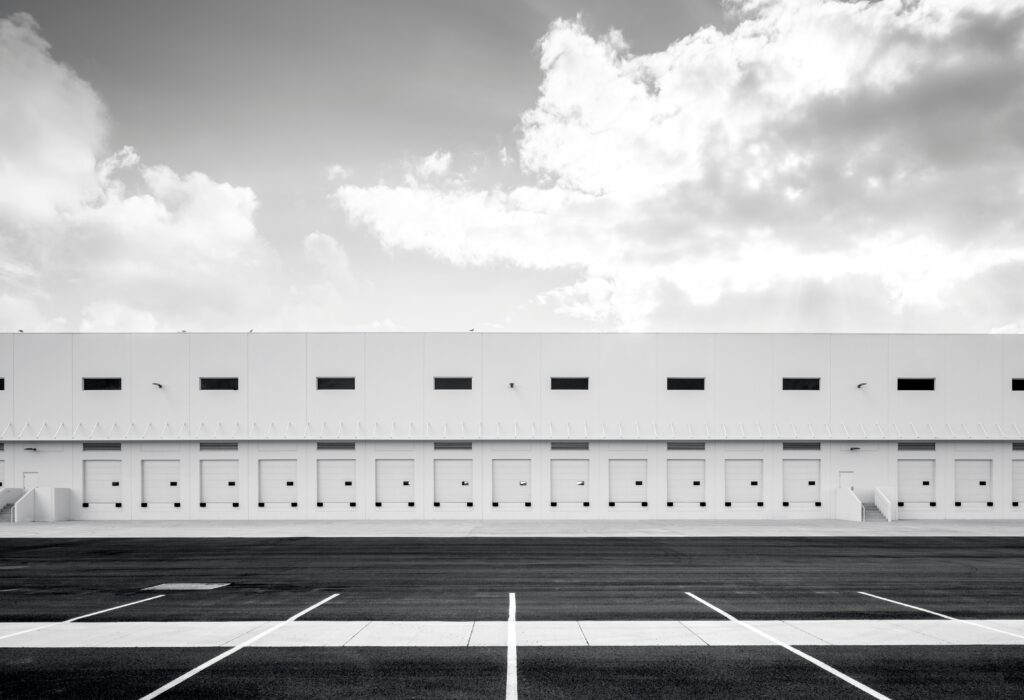
Industrial real estate is one of the few commercial property types where lenders are actively competing for business right now. Warehouses, light manufacturing buildings, and distribution centers are in demand — and the industrial property loan market reflects it. Getting the right loan structure depends on whether you’re an investor buying income-producing industrial, a business owner purchasing the building you operate from, or a value-add buyer looking at a vacant asset. Each path leads to a different program. Here’s what you need to know before you pick one.
What You’ll Learn
- What types of industrial properties lenders will and won’t finance
- Current industrial property loan rates by lender type (2026)
- LTV and DSCR requirements for industrial deals
- Which loan program fits your situation — investor, owner-occupant, or value-add buyer
- How lenders actually underwrite an industrial acquisition or refinance
What Counts as an Industrial Property?
Lenders define industrial properties by how they’re used: storage, distribution, manufacturing, and related logistics functions. Common subtypes include:
- Warehouse and distribution: Clear heights typically 24–36 feet, dock-high or grade-level loading, tractor access. The backbone of e-commerce fulfillment and last-mile logistics.
- Light industrial / flex: Smaller footprints, often 10,000–50,000 SF, with a mix of office and warehouse space. Popular with contractors, light manufacturers, and service businesses.
- Manufacturing: Heavy power requirements, specialized infrastructure, sometimes environmental exposure. More complex underwriting than standard warehouse.
- Cold storage / refrigerated: High replacement cost per square foot, specialized tenant base. Lenders treat these as a specialty asset class with tighter liquidity.
- Self-storage: Technically industrial in most markets, but underwritten on a separate set of metrics. Covered in its own loan guide.
The distinction matters because lender appetite varies significantly by subtype. A well-leased Class A distribution center in the Atlanta or Dallas metro is one of the easiest industrial deals to place. A single-tenant manufacturing facility with environmental history in a tertiary market is a different conversation.
Industrial Property Loan Rates in 2026
Per the Mortgage Bankers Association, commercial and multifamily borrowing increased 52% in Q1 2026 compared to the same period a year prior, and the MBA is projecting $805 billion in total commercial mortgage originations for the full year. Industrial properties are among the most active sectors within that volume. With lender appetite strong and credit spreads relatively stable, industrial financing rates in mid-2026 look like this:
| Loan Type | Rate Range | Term | Max LTV | Best For |
|---|---|---|---|---|
| Life company (perm) | 5.25%–5.75% | 10–25 year fixed | 65–70% | Institutional-quality assets, creditworthy long-term tenants |
| CMBS (conduit) | 5.75%–6.50% | 5–10 year fixed | 75% | Larger deals, secondary markets, near-term lease expirations |
| Bank / conventional | 5.50%–6.50% | 5–7 year term | 75% | Strong relationship borrowers, flexible underwriting |
| SBA 504 (owner-occ) | 5.00%–5.50% | 25-year fixed (SBA tranche) | 90% combined | Business owners buying their operating facility |
| Bridge | 9.00%–10.75% | 12–36 months, I/O | 70–75% | Value-add, lease-up, time-sensitive acquisitions |
Good news for borrowers: competition among lenders for quality industrial assets is real, and that competition shows up in term sheets. Don’t accept the first quote you receive.
LTV and DSCR: What Lenders Require
For stabilized industrial assets — occupied, with in-place leases generating predictable cash flow — most lenders underwrite to these parameters:
- LTV: 65–75% for most permanent programs; 55–65% for life company loans where pricing is most aggressive
- DSCR: 1.20x–1.25x minimum; some programs go to 1.15x for strong credit sponsorship on lower-leverage deals
- Occupancy: 90%+ at origination for most stabilized loan programs; partial vacancy pushes you toward bridge financing
- Loan size: $1M minimum for most bank programs; CMBS typically starts at $2M; life company minimums often start at $5M–$10M
One thing I see borrowers underestimate: lenders underwrite to the lease term, not the property’s theoretical value. If your anchor tenant’s lease expires in 18 months, even a building with healthy in-place NOI can see lender appetite compress significantly. In my experience, lenders shorten amortization or add reserves when lease term doesn’t match or exceed the loan term — sometimes both.
Loan Programs for Industrial Buildings
Investor-owned (income-producing) industrial
If you’re buying a leased warehouse or light industrial building as an investment, your primary options are bank loans, CMBS, and life company financing. Banks offer the most flexibility on underwriting — they’ll look at your full financial picture, not just the property — but they cap terms at 5–7 years with balloon payments. CMBS is better suited to larger assets, secondary markets, or properties where bank credit box won’t go. Life company money is cheapest on rate but requires low leverage and institutional-quality assets with creditworthy, long-term tenants.
We work with lenders across all three channels. For most value-add industrial acquisitions under $5M, a regional bank or credit union is usually the right starting point. For larger deals with creditworthy tenants and remaining lease terms exceeding 7 years, we shop CMBS and life company quotes before recommending a direction.
Owner-occupied industrial (SBA 504 and SBA 7(a))
Business owners buying the building they operate from have access to the most aggressive financing available in the market. The SBA 504 program lets you put as little as 10% down on an owner-occupied industrial purchase — including warehouses, light manufacturing, and distribution facilities — with the SBA tranche locked at a 25-year fixed rate. For business owners with 2+ years of operating history and clean financials, it’s often the best deal in the room.
The SBA 7(a) for commercial real estate is more flexible but caps at $5M total project cost. It’s a better fit when the borrower also needs working capital folded in, or when the property type or ownership structure doesn’t meet 504 guidelines. Both programs require the business to occupy at least 51% of the building.
Bridge loans for industrial value-add
Vacant buildings, short-term leases, properties needing capital improvements, or time-sensitive acquisitions all push toward bridge financing. Industrial bridge loans typically run 12–36 months at 9%–10.75%, interest-only, with a path to permanent financing once the asset is stabilized. The higher rate is the cost of speed or of buying before a property qualifies for permanent financing.
We’ve placed bridge-to-perm structures for industrial acquisitions where the borrower needed to move fast to close competitively, then refinanced into conventional permanent debt once the building was fully leased. If you have a vacant or transitional industrial asset, the right bridge lender can get you to stabilization without sitting on the sideline waiting for the property to qualify.
Looking at an industrial acquisition or refinance? We structure warehouse and industrial property loans nationally across bank, CMBS, SBA, life company, and bridge programs. Schedule a 15-minute call
How Lenders Underwrite an Industrial Deal
The key underwriting inputs for any industrial property loan are lease structure, building functionality, and environmental history. Here’s what lenders focus on:
- Lease analysis: In-place rent vs. market rent, remaining lease term, tenant credit quality, and lease structure (NNN vs. gross vs. modified gross). Single-tenant industrial with a creditworthy occupant on a long NNN lease commands the best terms. Multi-tenant flex with short-term leases is underwritten more conservatively.
- Physical functionality: Clear height, loading configuration (dock-high vs. grade-level), power capacity, and lot coverage ratio. Buildings that are functionally obsolete — low ceilings, inadequate power, no truck access — face tighter lender appetite and trade at a discount.
- Environmental exposure: Industrial properties carry the highest environmental exposure of any CRE asset class. A Phase I Environmental Site Assessment is required on virtually every deal; lenders may require a Phase II for certain prior uses or flagged site history. Budget $2,000–$4,000 for a Phase I.
- Cap rate and NOI analysis: Lenders work backward from the NOI to confirm DSCR at your requested LTV. Nationally, industrial cap rates have held in the 5.5%–6.5% range in 2026 depending on market and asset quality. CBRE reports that commercial real estate lending is at its highest level in five years, with industrial among the most active sectors.
For a cash-out refinance on a commercial property, the underwriting framework is the same, but lenders look hard at seasoning. Most want 6–12 months of ownership before pulling cash out and will order a fresh appraisal regardless of your original purchase price.
One note on market context: according to Plante Moran’s Q1 2026 Industrial Market Report, national industrial vacancy reached approximately 7% in Q1 2026. The headline masks a wide split — small-bay properties under 50,000 SF are sitting at roughly 4.2% vacancy while big-box distribution facilities carry the bulk of the overall increase. For lenders, that distinction matters: a well-located small-bay flex building is a much easier credit story than a large single-tenant spec distribution facility in a market with new supply.
From a Recent Deal
From a recent deal: I worked with a mechanical contractor who wanted to buy the 22,000 SF light industrial flex building his company had been leasing for six years. The landlord was retiring and motivated to sell. We structured it as an SBA 504 — 10% down from the borrower, 40% from the SBA tranche, 50% from the bank. The business had eight years of operating history and strong cash flow, which made the credit story clean. He closed in 58 days at a blended rate well below what conventional commercial would have offered, and his monthly payment came out slightly lower than his previous rent.
Frequently Asked Questions
What credit score do I need for an industrial property loan?
Most conventional commercial lenders want a minimum 680 credit score for principal borrowers; SBA programs typically require 680–700+. Life company and CMBS lenders focus more on the property’s cash flow and tenant quality than personal credit, though sponsors below 660 will face limited options and may need a co-borrower or additional equity to compensate.
Can I use an SBA 504 loan to buy a warehouse?
Yes — industrial and warehouse properties are among the most common SBA 504 use cases. The property must be at least 51% owner-occupied by your business at origination. The SBA 504 caps the SBA tranche at $5 million ($5.5M for certain manufacturing projects).
How much do I need to put down on an industrial property?
SBA 504 requires as little as 10% down. Conventional bank and CMBS loans typically require 25–35% equity. Life company programs want 35–45% equity (55–65% LTV). Investors buying income-producing industrial should plan for 25–30% down at a minimum on standard permanent financing.
Do lenders require environmental reports on industrial properties?
Yes, universally. A Phase I Environmental Site Assessment is required on every industrial transaction. Phase II investigations — soil and groundwater sampling — are common for properties with prior industrial use or any concerns flagged in the Phase I. Budget the time and cost into your diligence timeline before going under contract.
What’s a typical loan size for an industrial property loan?
Bank and SBA programs start around $500K–$1M. CMBS typically starts at $2M. Life company programs often have $5M–$10M minimums. Bridge lenders cover the widest range, from $1M to $100M+ depending on the capital source. Most small-bay industrial acquisitions fall in the $2M–$8M range.
Ready to Finance Your Industrial Property?
We work with investors and business owners nationally on industrial property loans — from light-industrial flex acquisitions under $2M to large warehouse and distribution center financing in Sunbelt and gateway markets. Our lender network spans bank, CMBS, SBA, life company, and bridge capital sources, so we’re matching each deal to the right program rather than running everything through the same credit box. Send us your scenario and we’ll respond within one business day with realistic terms.
This article is for informational purposes only and does not constitute financial, legal, or tax advice. Loan terms, rates, and availability vary by borrower, property, and market conditions. Consult Willowbrook Capital for scenario-specific guidance.
