
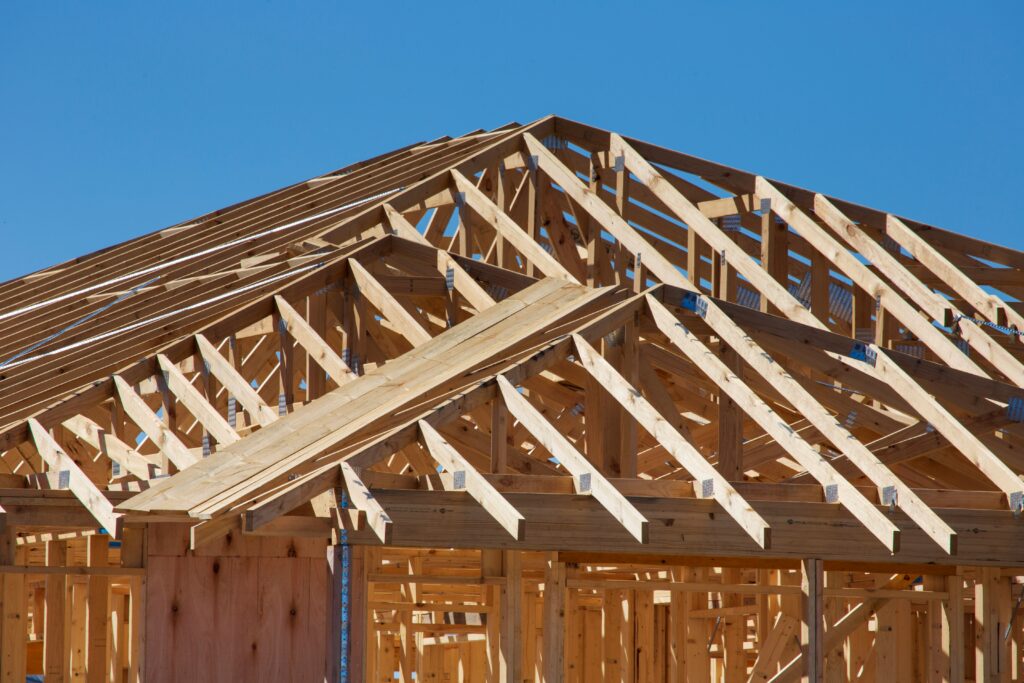
You just finished construction on a 4-unit rental property. The framing is done, the CO is in hand, and you’re ready to place tenants. But your construction loan has a 12-month term, and the clock is ticking. Can you refinance into a DSCR loan right now — before you even have a signed lease?
Yes. And understanding how lenders underwrite a new construction DSCR loan before a property has rental history is the difference between a clean exit and six months of scrambling.
What Is a New Construction DSCR Loan?
A DSCR loan qualifies you based on the property’s rental income rather than your personal income — no W-2s, no tax returns. Lenders calculate the Debt Service Coverage Ratio by dividing gross monthly rent by your total monthly payment (principal, interest, taxes, insurance, and HOA if applicable). A DSCR above 1.0 means the property generates more income than it costs to carry.
For an existing rental with a lease in place, that calculation is simple. For a newly completed property with no rental history, there’s no actual rent to plug in. That’s where the appraisal comes in.
How Lenders Calculate DSCR When There’s No Lease
Most non-QM DSCR lenders handle new construction the same way: they order a market rent schedule from the appraiser alongside the standard value appraisal. For single-family investment properties, this is typically Fannie Mae Form 1007 (the Single-Family Comparable Rent Schedule), which compares the property to similar rentals nearby and delivers the appraiser’s opinion of achievable monthly market rent. Two-to-four-unit properties use Form 1025.
The lender underwrites to the lower of the appraiser’s market rent or any actual lease you have in place. Per Fannie Mae’s rental income guidelines, the lower figure always controls — they don’t use whichever number helps the borrower.
The practical implication: if the appraiser supports $2,200/month in market rent on your new 3-bed/2-bath in Nashville, the lender will use $2,200 to calculate DSCR. If you already have a tenant signed at $2,050, they’ll use $2,050. Either way, you can close. What you cannot do is submit a projected rent figure you made up. It comes from the appraiser, period.
Requirements for a New Construction DSCR Loan in 2026
The core requirements look similar to standard DSCR programs, with a few adjustments for the construction context:
- Minimum FICO: Most lenders in our network require 680+ for new construction, compared to 640–660 for stabilized rentals. The higher floor accounts for the absence of operating history.
- LTV: 75% maximum is most common on new construction purchases and rate-and-term refis. Some programs allow 80% for borrowers with strong credit and healthy reserves.
- DSCR minimum: 1.0 using market rent. Some programs allow a DSCR as low as 0.75 at a higher rate, but 1.0 is the standard for clean pricing.
- Reserves: 6–12 months of PITIA is typical. New construction adds lease-up risk, so lenders want more cushion than they’d require on a property with a tenant already in place.
- Certificate of Occupancy required: The CO must be issued before closing. A DSCR lender won’t close on a property that isn’t legally habitable — this is a hard stop, not a guideline.
- Loan size: Most DSCR programs cover $100K–$3M for 1-4 unit residential investment properties. Larger balances typically require a commercial program.
One thing that doesn’t hurt you: the property’s age. In DSCR underwriting, a new build in a high-demand rental market can appraise stronger than a 40-year-old property with deferred maintenance — and support higher market rent than comparable older rentals. New doesn’t mean risky from a credit standpoint.
For a full breakdown of standard DSCR qualification criteria, see our DSCR loan requirements guide.
Seasoning: What You Need to Know Before Pulling Cash Out
This is where new construction DSCR gets more nuanced — and where I see the most borrower confusion.
If you’re refinancing out of a construction loan into a long-term DSCR product (rate-and-term refi), most lenders don’t require title seasoning. You have a CO, the appraiser supports market rent, your profile qualifies — you can close. This is the clean path for builders and developers who engineered their DSCR exit from the start.
If you want to pull cash out on a newly completed property, the rules tighten. Most DSCR lenders require at least 6 months of title ownership before a cash-out refinance. Some require 12. Within the first 12 months, many lenders cap cash-out LTV at 70%, regardless of the current appraised value.
The reason is straightforward: lenders don’t want to fund a cash-out refi based on a value established the day after CO, before the property has proven anything in the rental market. It’s a seasoning-risk protection they’ve built in after hard experience with new construction appraisal risk.
For investors following a build-and-hold strategy, that 6–12 month runway is worth planning around. Build it into your construction loan term from day one — most construction lenders offer 12–18 month terms for exactly this reason. It gives you time to complete, get CO, season the title, place a tenant, and exit into DSCR cleanly. For more on that strategy, see our post on build-to-rent financing.
Looking at a newly completed rental or ground-up project? We work with non-QM DSCR lenders that underwrite on market rent from day one. Schedule a 15-minute call →
Direct DSCR at Completion vs. Bridge-to-DSCR: Choosing the Right Exit
Two paths get investors from a newly built property into long-term financing:
Path 1 — Direct DSCR at completion. You refinance out of your construction loan directly into a 30-year DSCR product. Works best when: you have a CO, the appraiser supports solid market rent, your FICO is 680+, and you’re doing a rate-and-term refi rather than a cash-out. One closing, no bridge loan interest burn.
Path 2 — Bridge-to-DSCR. You pay off the construction loan with a short-term bridge loan, use that runway to season the title and place tenants, then refinance into a DSCR loan at 6 or 12 months. Works best when: you need to pull cash out later, your construction loan term is running short, or you want to stabilize rents before locking into a permanent rate.
The bridge adds cost — bridge rates typically run 150–300bps over comparable DSCR rates — but it buys time and flexibility. For investors targeting a meaningful cash-out, the extra months of seasoning can unlock 5–10% more LTV at full appraised value, often more than covering the bridge interest. See our bridge-to-DSCR guide for the full breakdown.
For most straightforward builds — single family, duplex, or small triplex/fourplex — I lean toward the direct DSCR exit if the borrower qualifies. Simpler is cheaper. When cash-out is the goal or the construction term ran tight, the bridge earns its cost.
From a Recent Deal
From a recent deal: I worked with a developer in the Nashville market who completed a duplex — one unit 3/2, the other 2/1 — and wanted to refinance out of his 12-month construction note on day 90 after CO. No tenants yet. The appraiser returned a market rent schedule supporting $2,100/month on the larger unit and $1,600/month on the smaller — $3,700 combined. Against a projected PITIA of roughly $3,200, that put his DSCR at 1.16. We closed a rate-and-term DSCR refi in 22 days. Both units were leased within 45 days of closing. Clean exit, permanently financed, zero bridge interest cost.
Frequently Asked Questions
Can I get a DSCR loan on a newly built property with no tenants?
Yes. Most non-QM DSCR lenders underwrite on market rent from the appraiser’s rent schedule rather than requiring an actual lease. You need a Certificate of Occupancy and a property in a market with documented rental demand.
What is the minimum DSCR for new construction?
Most lenders require a minimum 1.0 DSCR using the appraiser’s market rent figure. Some programs allow a sub-1.0 DSCR (down to 0.75) at a higher rate. The lender uses the appraiser’s supported rent — not a projected figure you provide.
How long until I can do a cash-out refinance on a newly built rental?
Most DSCR lenders require 6–12 months of title seasoning before allowing a cash-out refi on new construction. Within the first 12 months, cash-out LTV is typically capped at 70%. See our guide on DSCR loan refinancing for full timing details.
Do I need landlord experience to qualify for a new construction DSCR loan?
No. DSCR loans don’t require prior investment property experience. Qualification is based on the property’s projected income and your credit profile. Prior experience can support stronger terms with some lenders, but it isn’t a gating requirement.
What appraisal form does the lender order for market rent on new construction?
For single-family investment properties, lenders typically order Fannie Mae Form 1007 (Single-Family Comparable Rent Schedule). For 2–4 unit properties, the appraiser uses Form 1025. These forms document comparable rental transactions and deliver the appraiser’s opinion of achievable monthly rent, which the lender uses for DSCR underwriting.
Ready to Finance Your New Construction Rental?
We’re a commercial mortgage brokerage serving real estate investors and developers nationally, with active lender relationships across DSCR, bridge, ground-up construction, and other business-purpose mortgage programs. Send us your scenario — we’ll respond within one business day with realistic terms.
This article is for informational purposes only and does not constitute financial, legal, or tax advice. Loan terms, rates, and availability vary by borrower, property, and market conditions. Consult Willowbrook Capital for scenario-specific guidance.
