
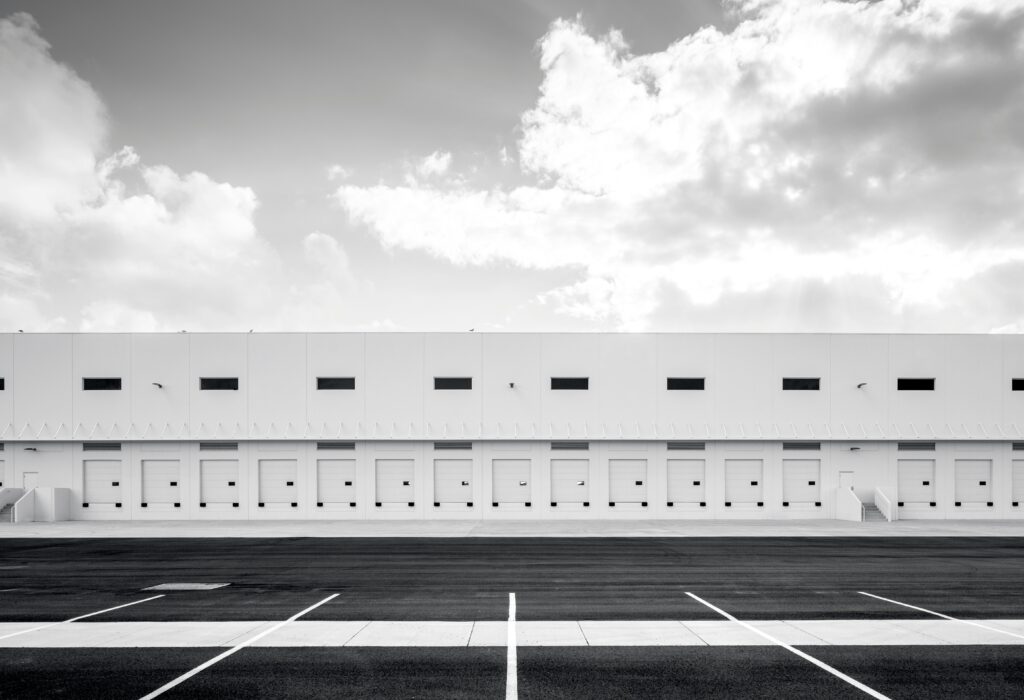
Most business owners I talk to about industrial property are in the same situation: they’ve been leasing warehouse or light manufacturing space for years, writing rent checks that build their landlord’s equity instead of their own. An SBA warehouse loan changes that math. For qualifying businesses, it’s possible to purchase the industrial building you operate in with as little as 10% down — and lock in long-term financing that often costs less per month than the lease it replaces.
This guide covers how SBA warehouse loans work, the two programs available (504 and 7(a)), current rates and loan limits in 2026, and what underwriters actually look at when you apply.
What you’ll learn:
- How SBA 504 and SBA 7(a) each structure a warehouse purchase
- Down payment requirements and loan limits for each program
- Current rate ranges in mid-2026
- The occupancy rule that determines eligibility
- What a typical underwriting timeline looks like
What Is an SBA Warehouse Loan?
“SBA warehouse loan” isn’t a distinct SBA product — it’s a descriptor for using the SBA’s two flagship real estate programs (504 and 7(a)) to finance an industrial or warehouse property that the borrowing business will occupy.
Both programs are designed for owner-occupied commercial real estate. The property can be a warehouse, distribution center, light manufacturing facility, flex industrial space, or a building that combines warehouse and office. What they have in common: the business purchasing the property actually uses it. Neither program is designed for investor-owned industrial properties rented entirely to third parties — that falls into conventional or CMBS commercial financing.
If you’re a business owner who has been renting industrial space and wants to own it instead, you’re in the right lane. The SBA’s 504 Loan Program is the most commonly used structure here, but the 7(a) program has a real place too — particularly for smaller deals or situations where the borrower needs to bundle real estate with equipment or working capital financing.
For a broader overview of how SBA 7(a) works across commercial property types, see our SBA 7(a) Commercial Real Estate guide.
SBA 504 vs. SBA 7(a) for Warehouse Purchases
These two programs structure the financing differently and serve somewhat different needs.
| Feature | SBA 504 | SBA 7(a) |
|---|---|---|
| Max loan amount | ~$14M+ total (CDC portion up to $5.5M) | $5M |
| Down payment | 10% (established business, standard property) | 10–20% |
| Rate structure | Fixed rate on SBA/CDC portion | Variable (prime-based) |
| 2026 effective rate (SBA portion) | ~6.0–7.5% | ~9.0–13.25% |
| Loan term | 10, 20, or 25 years | Up to 25 years |
| Eligible uses | Real estate and heavy equipment only | Real estate, equipment, working capital, business acquisition |
| Best for | Larger warehouse acquisitions | Smaller deals or mixed-use financing needs |
SBA 504 works through a two-lender structure: a conventional bank covers 50% of the total project cost, a Certified Development Company (CDC) provides up to 40% backed by the SBA, and the borrower contributes 10%. The CDC portion carries a fixed rate set at the time of debenture funding — a meaningful advantage when you’re locking in 20–25 year financing. That fixed rate has been running in the 6.0–7.5% range in mid-2026, while the bank first lien is generally priced at market — typically 6.5–8.0% on a 10-year term with a balloon.
SBA 7(a) is a single-lender structure where one bank makes the full loan with a partial SBA guarantee (up to 85% on loans of $150,000 or less; up to 75% on larger amounts). Rates are variable and capped at prime plus a set spread — currently ranging from approximately 9.0% to 13.25% depending on loan size. The prime rate sits near 6.75% as of mid-2026. The variable rate is the real drawback for long-hold real estate, but the program’s flexibility is a genuine advantage: 7(a) proceeds can fund real estate, equipment, leasehold improvements, and working capital in a single closing.
My read: For a straightforward warehouse acquisition of $1M or more with a long hold horizon, I steer most clients toward 504. The fixed rate and low down payment matter over a 20–25 year period. The 7(a) earns its place for smaller transactions, faster closings, or borrowers who need to wrap equipment and renovation costs into the same loan.
How Much Can You Borrow — and What Are Rates?
Under SBA 504, there’s no hard cap on total project size. The CDC/SBA debenture maxes out at $5.5M for most businesses, but the conventional bank piece can go higher. In practice, we structure 504 warehouse deals from about $750,000 to well over $10M in total project cost.
Under SBA 7(a), the maximum loan is $5M — which covers most small-business warehouse purchases.
The broader lending environment supports both programs right now. The Mortgage Bankers Association forecast total commercial and multifamily mortgage originations at $805 billion for 2026 — a 27% increase over 2025 and the highest volume since 2022. Owner-occupied SBA transactions are a meaningful part of that activity as businesses capitalize on rate stabilization following the Fed’s 2025 easing cycle.
Current 2026 rate benchmarks:
- SBA 504 debenture (fixed): 6.0–7.5% over 25 years
- 504 first mortgage (bank portion): 6.5–8.0%, typically 10-year term
- SBA 7(a) variable: Approximately 9.0–9.5% on loans over $350K at current prime
The effective blended rate on a 504 deal — combining the bank piece and the SBA debenture — typically lands in the 7–8% range depending on how the bank prices its portion. That’s materially below what conventional commercial real estate loans cost for industrial properties right now, and with a much longer term and lower equity requirement.
Who Qualifies? The Occupancy and Eligibility Rules
The SBA’s occupancy requirement is the first gate:
- Existing buildings: The borrowing business must occupy at least 51% of the usable square footage at closing.
- New construction or substantial renovation: Must occupy at least 60% of the building.
This means a business can lease up to 49% of an existing warehouse to third-party tenants and still qualify for SBA financing — a setup I see often with manufacturers or distributors who want some rental income while building equity. The tenant income also gets factored into cash flow analysis, which can help the deal pencil.
Beyond occupancy, the business must:
- Qualify as a small business under SBA size standards
- Operate as a for-profit enterprise based in the US
- Demonstrate creditworthiness and ability to repay — personal and business credit, two to three years of financial statements
- Contribute the required equity injection at closing — 10% for most established businesses, 15–20% for special-purpose properties or startups
Special-purpose properties — cold storage, fuel facilities, car washes, hotels — require 15% down under SBA 504 because they’re harder to repurpose if the business fails. Standard warehouse and flex industrial spaces qualify at 10%.
What the Underwriting Process Actually Looks Like
SBA warehouse loans don’t close as fast as conventional commercial loans. Plan for 60–90 days for a 504 transaction and 45–75 days for 7(a), depending on the bank, the CDC, and the complexity of your deal.
The underwriting package typically includes:
- Two to three years of business tax returns and financial statements
- Year-to-date profit and loss statement and balance sheet
- Personal financial statement for all owners with 20%+ equity
- Business plan (if relocating or expanding into a new facility)
- Property appraisal by an SBA-approved appraiser
- Phase I environmental site assessment (required on every SBA real estate deal)
The environmental requirement catches people off guard. For warehouse and industrial properties, Phase I is non-negotiable — and if the Phase I flags potential contamination, you may need Phase II testing, which adds weeks and cost. I tell clients to order the environmental report the day they go under contract. Don’t wait for the SBA application to get moving on it.
We work with lenders across both programs nationally and can help match your deal to the right CDC and bank combination. If you’re also curious about conventional industrial financing that doesn’t require owner-occupancy, see our industrial property loan overview.
From a recent deal: I recently helped a manufacturing client in the Southeast close an SBA 504 on a 22,000 sq. ft. light industrial building they’d been leasing for six years. Total project was just under $3M — the bank covered 50%, the CDC funded 40% at a fixed rate below 7%, and the client brought 10% to closing. Their monthly payments came out lower than what they’d been paying in rent. They walked out of closing owning the building. That’s about as clean a result as this program produces.
Looking at a warehouse or industrial building your business could own? We structure SBA 504 and 7(a) transactions nationally. Schedule a 15-minute call →
What to Do If You Already Own the Building
If you already purchased your warehouse with conventional financing and want to refinance into better terms, the SBA 504 Refinance program may apply. See our guide on SBA 504 refinancing for owner-occupied commercial buildings for details on how that works.
Frequently Asked Questions
Can I use an SBA loan to buy a warehouse if I plan to lease part of it?
Yes — as long as your business occupies at least 51% of the building at closing (60% for new construction). You can lease up to 49% of an existing warehouse to third-party tenants and still qualify for SBA 504 or 7(a) financing. That rental income typically gets factored into the cash flow analysis as well.
What’s the minimum down payment for an SBA warehouse loan?
10% for an established business purchasing a standard warehouse under SBA 504. That increases to 15% for special-purpose properties (cold storage, certain manufacturing facilities) and to 15–20% for businesses operating fewer than two years.
How long does an SBA warehouse loan take to close?
SBA 504 typically closes in 60–90 days from application. SBA 7(a) runs 45–75 days depending on lender and complexity. The most common delays: missing documents, a Phase I that flags environmental concerns requiring Phase II, or appraisal challenges on unusual property types. Front-load your document package and order the environmental report early.
Can I use an SBA loan to buy a warehouse I don’t currently occupy?
Yes. The SBA doesn’t require that you currently occupy the property — only that your business will occupy at least 51% after closing. Businesses relocating or expanding into a new facility qualify under the same rules as those buying their current space.
Ready to Finance Your Warehouse?
We’re a commercial mortgage brokerage working with business owners and investors nationally on SBA 504, SBA 7(a), and conventional owner-occupied industrial financing. Send us your scenario — we’ll respond within one business day with realistic program options.
Get a Quote → | Email Patrick directly
This article is for informational purposes only and does not constitute financial, legal, or tax advice. Loan terms, rates, and availability vary by borrower, property, and market conditions. Consult Willowbrook Capital for scenario-specific guidance.
