
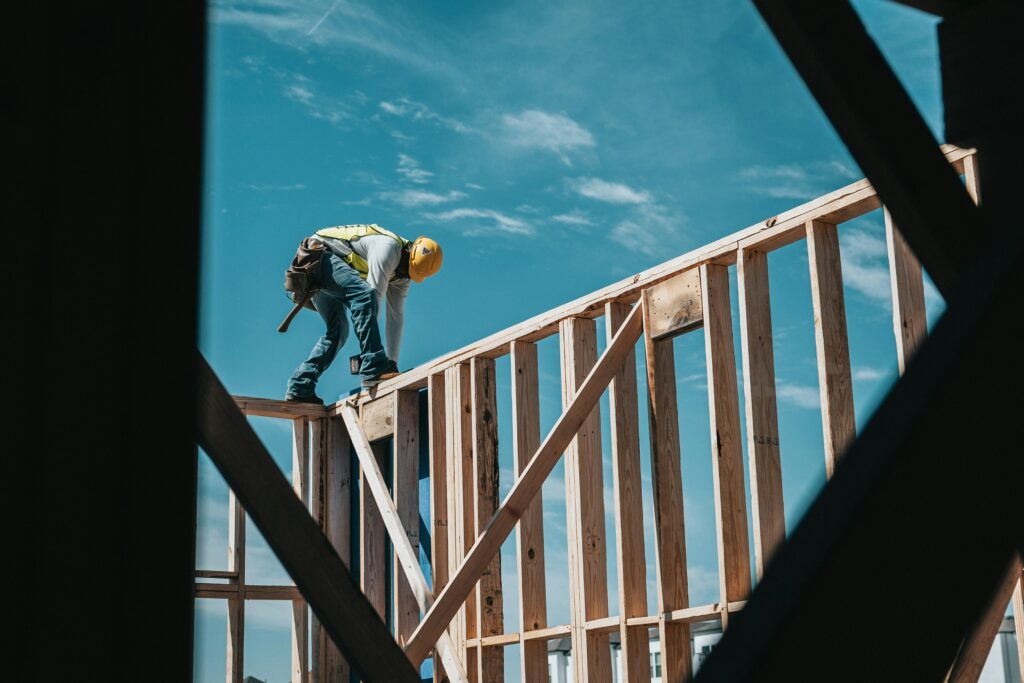
A builder I work with in the Carolinas had a lot, a permit, and a plan for a 2,400-square-foot house with no buyer attached. Her bank would not touch it without a signed contract. That gap is exactly what a spec home construction loan fills: financing to build a house on speculation, then repaying the loan when it sells.
Getting a spec home construction loan is harder than getting a pre-sold construction loan, and the 2026 market is making lenders pickier. Here is how the loans work, what they cost, and what lenders want to see before they fund.
What Is a Spec Home Construction Loan?
A spec home construction loan finances a new single-family home (or a small group of them) that a builder starts without a signed purchase contract. The builder owns the lot, builds on a draw schedule, and sells the finished home to repay the loan.
This is business-purpose lending to a builder or developer. It is not a consumer mortgage, and the borrower is not the future occupant.
Lenders treat it as riskier than a pre-sold build for one reason: the exit is a sale that has not happened yet. Every underwriting decision traces back to that one fact.
How Do Builders Finance a Home Without a Buyer?
Most spec home construction loans are short-term, interest-only, and funded in draws as work is completed. The structure looks like this:
- Term: 12 to 18 months, often with one extension option.
- Leverage: roughly 75% to 85% of cost (LTC) and 65% to 75% of the as-completed value (LTV), whichever is lower.
- Payments: interest-only on the amount drawn, usually paid from an interest reserve.
- Equity: the builder funds the land (or the lender counts it toward equity) plus the gap between the loan and total cost.
- Exit: sale of the home, or a refinance into a bridge or DSCR loan if the builder decides to rent it.
Bank programs are cheaper but come with tight spec limits. Private and debt-fund construction lenders go higher on leverage and move faster, at a higher price. Which one fits depends on your track record and how quickly you need to start.
For the mechanics of how money moves during the build, see our guide to the construction draw schedule. If you are still deciding between products, our comparison of a construction loan vs. a bridge loan covers the tradeoffs.
What Does a Spec Home Construction Loan Cost in 2026?
Rates are tied to the prime rate, and prime moved. After the Federal Reserve’s September increase, major banks raised prime to 7.00%, which pushes up the cost of every floating-rate construction loan. We broke down the broader effect in our post on the Fed rate hike and commercial real estate loans.
Here is the range I see across capital sources for spec work right now:
| Lender type | Typical rate | Typical leverage | Spec limits | Speed to close |
|---|---|---|---|---|
| Community bank / credit union | Prime plus 0.5% to 1.5% | 75% LTC / 65-70% LTV | Strict (often 1 to 3 unsold homes at once) | 45 to 75 days |
| Debt fund / private construction lender | 10% to 12% plus 1 to 2 points | 80-85% LTC / 70-75% LTV | Flexible, based on track record | 15 to 30 days |
| Line of credit for repeat builders | Prime plus 1% to 2% | 70-75% LTC | Revolving, tied to sales velocity | Slow to set up, fast afterward |
Those are ranges, not quotes. Your actual terms depend on experience, liquidity, market, and the price point of the house.
What Do Lenders Require for a Spec Home Construction Loan?
Lenders underwrite the builder first and the house second. For a spec home construction loan, expect to provide:
- Builder experience: typically two or more completed projects similar in size and price point. If you lack that, a qualified general contractor can sometimes carry the experience requirement.
- Liquidity: cash and reserves, commonly 10% to 15% of the loan amount, after closing.
- Market data: comparable sales, absorption rates, and days on market in the submarket.
- Plans, budget, and schedule: a line-item budget with a contingency, permits, and a realistic timeline.
- Credit and financials: personal and entity tax returns, a schedule of real estate owned, and a personal guarantee in almost every case.
Bank regulators set the outer boundary for regulated lenders. Under the FDIC’s supervisory loan-to-value limits, 1-to-4 family residential construction loans are capped at 85% LTV. Most banks sit well below that on spec deals.
Why Are Lenders More Cautious on Spec Homes Right Now?
Because new homes are sitting longer. The Census Bureau’s August 2026 new residential sales report shows 483,000 new houses for sale and 8.5 months of supply, including 113,000 completed homes with no buyer.
Builder sentiment tells the same story. The NAHB’s October 2026 index fell to 29, its lowest reading since June 2012. According to NAHB, 43% of builders cut prices, with an average cut of 6%, and 65% used sales incentives.
For a spec borrower, that changes the math. Lenders now stress-test the sale price, extend the assumed time on market, and ask for a larger interest reserve. If your pro forma assumes the house sells in 30 days at full list, expect pushback.
From a recent deal: I recently structured a spec loan for a builder putting up three single-family homes on adjoining lots in a Raleigh-area suburb. The first bank wanted two pre-sales before funding. We went to a construction lender in our network that underwrote to the builder’s last six completed homes instead, closed at 80% LTC with an 18-month term, and sized the interest reserve for nine months of carry after completion rather than three. The homes sold in month 14 and 16, and the extra reserve meant the builder never had to come out of pocket on interest.
Building without a buyer lined up? We structure spec and ground-up construction deals nationally. Schedule a 15-minute call →
How Does the Interest Reserve Work on a Spec Home Loan?
The interest reserve is a line item in the loan budget that pays your monthly interest for you. Instead of writing a check each month, the lender draws from the reserve and adds it to the loan balance.
On spec deals, size it for the build period plus a realistic marketing period. Three months of carry after completion is thin in this market. Six to nine is safer. Our guide to the interest reserve on construction loans walks through the math.
What Are the Biggest Risks and How Do You Manage Them?
Spec building rewards discipline. These are the failure points I see most often:
- Overbuilding for the neighborhood. A house priced 15% above the best comp will sit. Build to the comps, not to your margin target.
- Too many unsold homes at once. Two unsold completed homes are manageable. Five can sink a small builder.
- Thin contingency. Budget 5% to 10% for cost overruns. Material and diesel costs are climbing, per NAHB.
- No plan B. If the home does not sell, can it be rented? A DSCR refinance is a clean fallback. See our post on the ground-up construction loan for how takeout financing fits in.
Hold back some of your own cash for carry. Lenders notice when a builder has reserves beyond the minimum, and so do the buyers’ agents who see a home sitting for 90 days.
Frequently Asked Questions
Can you get a construction loan for a spec home?
Yes. A spec home construction loan exists specifically for homes built without a buyer. Banks usually limit how many you can carry at once, and private construction lenders offer more flexibility at a higher cost.
How much down payment do you need for a spec home loan?
Plan on 15% to 25% of total project cost in equity, which can include the land. Banks lean toward the higher end; private lenders can go lower for experienced builders.
What is the difference between a spec loan and a pre-sold construction loan?
A pre-sold loan has a signed buyer, so the lender’s exit is nearly guaranteed. A spec loan has no buyer, so lenders cut leverage, charge more, and underwrite the builder’s track record harder.
How long does a spec home construction loan last?
Most run 12 to 18 months, interest-only, with an extension option. Build time plus a realistic sales period should fit inside the term.
Can a first-time builder get a spec loan?
It is difficult but possible. Lenders want proof of experience, so first-timers often partner with an experienced general contractor or start with a single home.
Ready to Finance Your Spec Build?
We’re a commercial mortgage brokerage serving builders and developers nationally, with active lender relationships across bank, credit union, and private construction programs. Send us your scenario and we’ll respond within one business day with realistic terms.
This article is for informational purposes only and does not constitute financial, legal, or tax advice. Loan terms, rates, and availability vary by borrower, property, and market conditions. Consult Willowbrook Capital for scenario-specific guidance.
